
Last month we sold a tested Marshall speaker to someone in Naples. Via Vinted. The buyer sent a short message — Vinted translates automatically, but you can see the original underneath. "Condizioni perfette?" Perfect condition? The answer: yes. The speaker was in perfect condition. It had originally been returned by a customer in Antwerp who found it "too big" for his bookshelf.
The buyer in Naples found it just right.
It wasn't a big transaction. One speaker, 67 euros, a few days' delivery. But it's the kind of sale that gets me thinking. Because we sell mainly in Belgium and the Netherlands — that's our home market, our patch, the place where we know the customer and the customer knows us. But every now and then, via Vinted, something slips across the border. To Germany. To France. To Italy. And each time you learn something about a market you don't know, but which is closer than you think.
Our map — and everyone else's
In 2017 eBay Inc. published a series of maps showing Europe's "seller hotspots" — the regions in Germany, the United Kingdom, France, Italy and Spain where most e-commerce entrepreneurs were active. Earlier that year Reuters had already reported that the number of millionaire sellers on eBay had risen from 731 to 1,095 in four years in Germany, and from 443 to 663 in the United Kingdom. Together, those two markets accounted for 30% of eBay's total net revenue — almost 9 billion dollars.
Belgium wasn't on those maps. Understandably — eleven million inhabitants, smaller than many a German federal state. In pure volume we're a footnote.
But I recognise the pattern those maps showed. E-commerce doesn't spread evenly. There are clusters — urban regions with logistics infrastructure, a retail tradition and a critical mass of entrepreneurs who pull each other along, knowingly or not. The British IBTimes wrote at the time about Leicester as a surprising eBay hotspot, a city you'd sooner associate with football than with online trade.
The Flemish Diamond — Ghent, Antwerp, Brussels, Leuven — is exactly that kind of cluster. Good motorways, bpost infrastructure that is improving fast, a port that can ship anything, and a concentration of small e-commerce businesses that is larger than you'd expect. We're right in the middle of it. In East Flanders, with a Belgian VAT number and a warehouse ten minutes from the E40.
Why we're sticking with Belgium and the Netherlands — for now
I'll be honest. The temptation to go cross-border is strong. The figures are enticing.
The European cross-border e-commerce market reached revenue of 358.7 billion euros in 2024/2025, 70% of which — some 247.5 billion — went through online marketplaces. That's according to the "TOP 100 Cross-Border Marketplaces Europe" report by Cross-Border Commerce Europe, published in October 2025. France is now Europe's largest e-commerce market at 175.3 billion euros in 2024, followed by Spain, which overtook Germany — 95.2 billion against 94 billion.
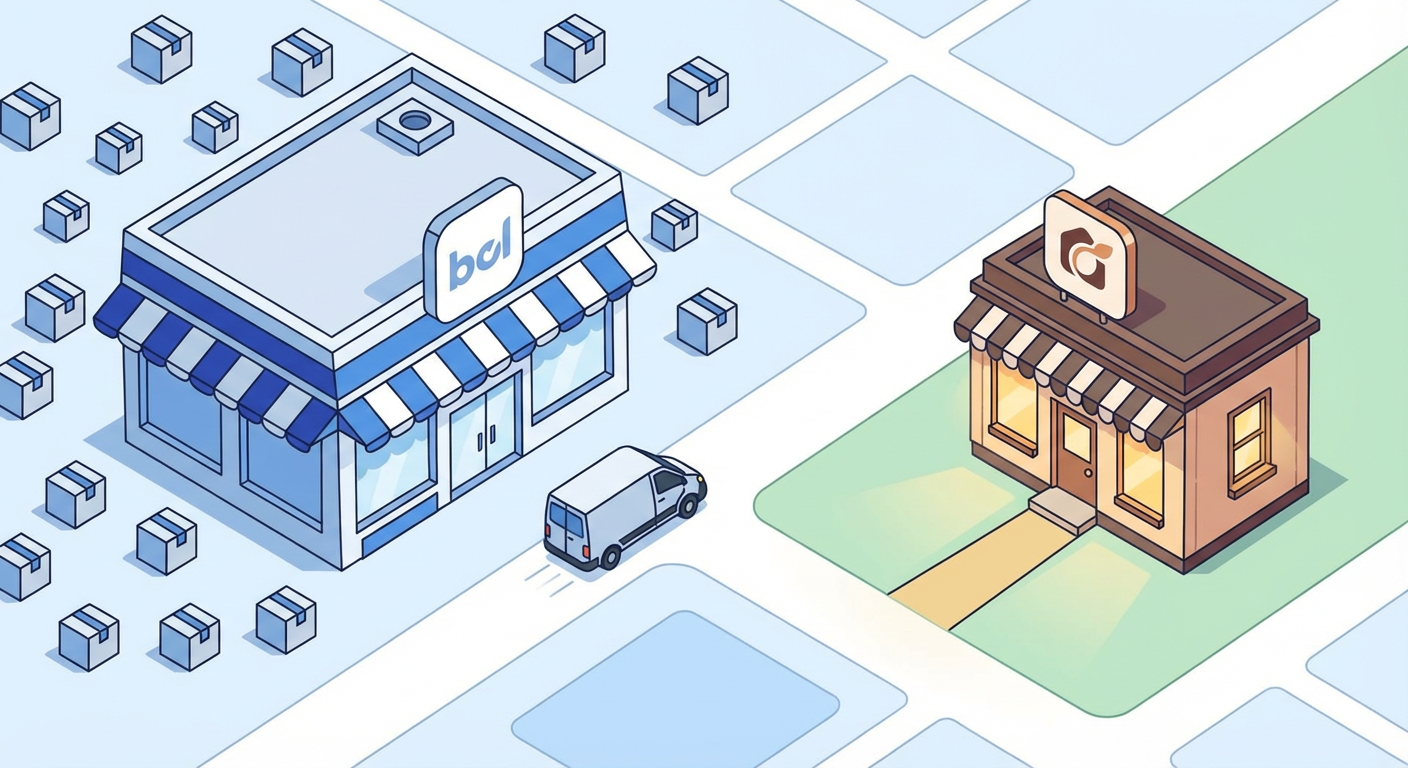
And us? Belgian consumers spent 17.4 billion euros online last year, a healthy rise of almost 7%. But 34% of that spending went to foreign web shops — to Bol.com in the Netherlands, to Zalando in Germany, to Amazon in Luxembourg. The Belgian market is big enough to be interesting, but small enough to keep leaking to its neighbours.
Still, we're staying put. For now. And that's a deliberate choice, not a lack of ambition.
Look. We sell tested returned electronics. It's a category that runs on trust. The customer has to believe that the product has been tested, that the description is accurate, that the scratch we mention really is the only scratch. You don't build that trust with a translated product page and a supplier nobody knows. You build it by being there. By knowing the customer. By working in the same time zone and the same language.
On Bol.com we know the Belgian and the Dutch customer. We know the Dutch return things faster than Belgians — the figures from Ecommerce News Europe confirm it: more than seven in ten Belgian consumers rarely or never return anything they order online. That's a striking difference from the DACH region, where return rates sit structurally between 20 and 28%.
We know what kind of questions we get. We know how quickly the customer expects an answer. We know that "B-grade" in Belgium doesn't carry the same connotation as "refurbished" in Germany, where the whole category is far more common.
That knowledge is our margin. Not in euros — in trust.
What Vinted teaches us about the rest of Europe
And then there's Vinted. The platform we never planned as a strategic channel, but which gives us a window onto markets we don't otherwise serve.
Via Vinted we occasionally sell to buyers in Germany, France, Italy and Spain. Not in large volumes — these are individual products that find the right buyer, whatever the borders. A pair of headphones to Lyon. A smartwatch to Munich. That Marshall speaker to Naples.
What strikes me about those sales — and I'm going on dozens of transactions, not thousands, so take it for what it is — is the difference in buying behaviour.
The German Vinted buyer negotiates. Always. The first response is almost invariably an offer 20 to 30% below the asking price. That's culture, not an insult — in Germany, buying second-hand is a negotiation, not a transaction. The French buyer asks more questions about the condition of the product but haggles less over the price. The Italian buyer — as far as I can generalise from a handful of sales — is the most enthusiastic. "Condizioni perfette?" And if the answer is yes, the deal is done.
I know this is anecdotal. But it confirms something the data shows too: the European refurbished market is not a monolith. Every country has its own relationship with second-hand goods, with returns, with the idea that a product can have a second life.
According to the ChannelEngine report, the European refurbished consumer electronics market — worth 7.7 billion euros in 2023 — grew fastest in Southern Europe, where the combination of price sensitivity and growing e-commerce adoption creates a gap in the market. How that market came about is a story in itself. My experience on Vinted, however limited, matches the direction the data shows.
The opportunity economy — seen from a warehouse in East Flanders
Politico EU wrote a piece on what it called the "opportunity economy" — the way online marketplaces make a new generation of entrepreneurs possible. No start-up capital needed. No lease. No staff on day one. Just start.
I recognise that story. It's our story.
Without Bol.com and eBay, Secondbay wouldn't exist. Those platforms gave us the customers, the payment infrastructure and the trust that an unknown little Belgian company needs to make that first sale. Vinted then gave us something else: a look across the border. Low-threshold, without the risks of a real European expansion, but with enough information to understand where the opportunities lie. And in the end those platforms also made us realise that we needed a place of our own — alongside those platforms, not instead of them.
And the opportunities are there. That much is clear.
European e-commerce revenue grew to 842 billion euros in 2024. The refurbished market is growing by 50% in two years. The circular economy is no longer a niche but a policy priority of the European Commission. And in all those markets — Germany, France, Italy, Spain — there are consumers looking for exactly what we offer: tested, honestly described electronics at a fair price.
But — and this is the nuance missing from most "scale your business to Europe" stories — you should grow when you're ready for it. Not when the market figures tempt you.
We're not ready yet. Not quite. Logistics to Germany are different from logistics to Mechelen. Keeping up with VAT rules in four countries is a job in itself. And customer service in a language that isn't your mother tongue takes more time and produces more mistakes than you'd think.
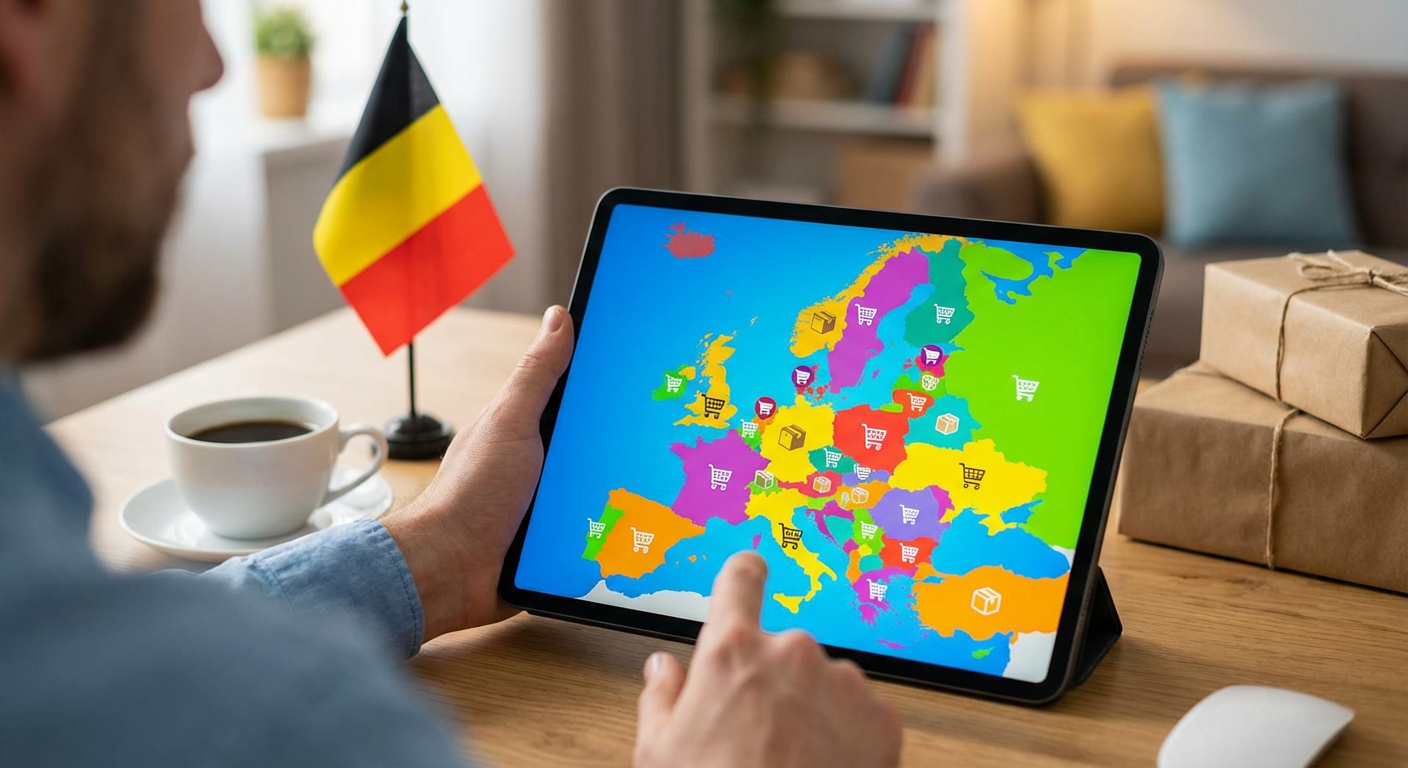
So for now we do what we do well: Belgium and the Netherlands. With the occasional excursion via Vinted. And with the map of Europe on the desk, ready for the moment we really are ready.
That speaker in Naples
The buyer sent another message last week. Vinted translated it neatly, but the original was underneath — Italian, three lines, with a loudspeaker emoji.
He asked whether we had any more Marshall speakers.
We had three left. One with a small scratch on the back, two in as-new condition. I sent him the photos — of the scratch and of the two without. He chose one of the two without. Paid, shipped, delivered.
Two Marshall speakers to Naples in one month. That's not a European expansion strategy. That's someone who knows what he's looking for and someone who has it.
Sometimes that's enough.
Bronnen
- EuroCommerce / Ecommerce Europe Foundation. "European E-Commerce Report 2025" (2025) eurocommerce.eu
- Cross-Border Commerce Europe. "TOP 100 Cross-Border Marketplaces Europe" 6e editie" (2025) cbcommerce.eu
- Ecommerce News Europe. "Belgians spent 17.4 billion euros online in 2024" (2025) ecommercenews.eu
- eBay Inc. "Putting eBay's European Sellers on the Map" (2017) ebayinc.com
- Reuters via Yahoo Finance. "eBay millionaire sellers in Germany and UK grow 50 percent in four years" (2017) finance.yahoo.com
- IBTimes UK. "Forget about football, Leicester is among Britain's most popular cities for eBay sellers" (2017) ibtimes.co.uk
- ChannelEngine / Cross-Border Commerce Europe. "TOP 100 Consumer Electronics Retail Europe 2024" (2024) cbcommerce.eu
- Statista. "E-commerce returns in Europe" — statistics & facts" (2025) statista.com