
Late shipments rose by 26 to 32 percent across Belgium, Germany and the Netherlands. That is not a line from an annual report. That is what logistics data company FourKites measured in the week of 11 July 2021, when the water in the Vesdre valley stood up to the first floor and e-commerce in the region — a sector that lives on the promise of delivery tomorrow — could not keep that promise for the first time in years.
Waiting times at distribution centres rose by 14 percent in Belgium and by 10 percent in Germany. Roads were cut off. Bridges were gone. Sorting centres ran on emergency power or did not run at all. And in the Liège region, 41,000 households were without electricity — which means: no wifi, no router, no laptop that charges, no Bol.com app that opens.
I sometimes think of those days when I go through our order list. Most orders go the way they should: someone looks for a tablet, compares, orders, receives, and in the best case we never hear from them again. That is e-commerce as it ought to be — quiet and efficient. But now and then there is something else. A cluster of orders from the same region. The same categories — tablets, laptops, smartphones. The basic devices. Not the gadgets, not the accessories. The things you need in order to function.
After July 2021, Liège was one such cluster.
The week e-commerce became essential infrastructure
There is an image of natural disasters that is wrong, and it goes like this: the disaster happens, the emergency services arrive, the water recedes, and then the rebuilding begins. As if it were a line with a beginning and an end. It is not. It is a web. And in that web there is a thread that almost nobody names: digital reconstruction.
In Belgium, more than 71,000 damage claims were filed after the 2021 floods, for a total of 2.1 billion euros. Those are figures from Assuralia, the Belgian insurers' federation. On top of that: 6,602 damaged cars, most of them written off. The Walloon government estimated the total damage for the region at 2.8 billion. MunichRe put the European damage at 46 billion.
Look. Behind those numbers is a family returning to a house where the television, the laptop, the router, the chargers, the modem, the games console and the kitchen appliances all became unusable in a single night. Insurance covers the contents — if you are lucky, if you have the right policy, if you are not underinsured. Many families in the Vesdre valley only discovered after the disaster that they were.
And then you have to replace it all. At once. But the local electronics shop in Pepinster — if there even was one — is itself under water. The Mediamarkt in Verviers is closed. The roads are impassable. And you no longer have a car, because it is floating somewhere in a car park.
What is left: a smartphone — if it still works — and an internet connection at the neighbours'. Or at the municipal shelter. Or nowhere, for eleven months, because that is how long it took before the last communities in the affected area had telecommunications again.
Eleven months.
In that context, e-commerce stops being a convenience. It becomes infrastructure. It becomes the way a family orders a laptop again for the children who have been doing their homework on paper for weeks. It becomes the channel through which you find an affordable router, a tablet you can use to fill in your insurance forms, a smartphone you can use to call the contractor who has already failed to show up three times.
The cost of a faltering chain
But then again — if you think the problem stops with the people who have lost their devices, you're missing half the story. The other half lies in the chain that has to supply those devices.
In 2011, the waters in Thailand flooded hundreds of factories, including the facilities where a large share of the world's hard drives were produced. Fourteen thousand companies worldwide felt the consequences — from carmakers in Japan to computer builders in Texas. Consumer electronics prices rose for months. That is not a Belgian example, but it illustrates something that has only become more relevant since: the global electronics chain is fragile. One knot that fails, and the whole structure trembles.
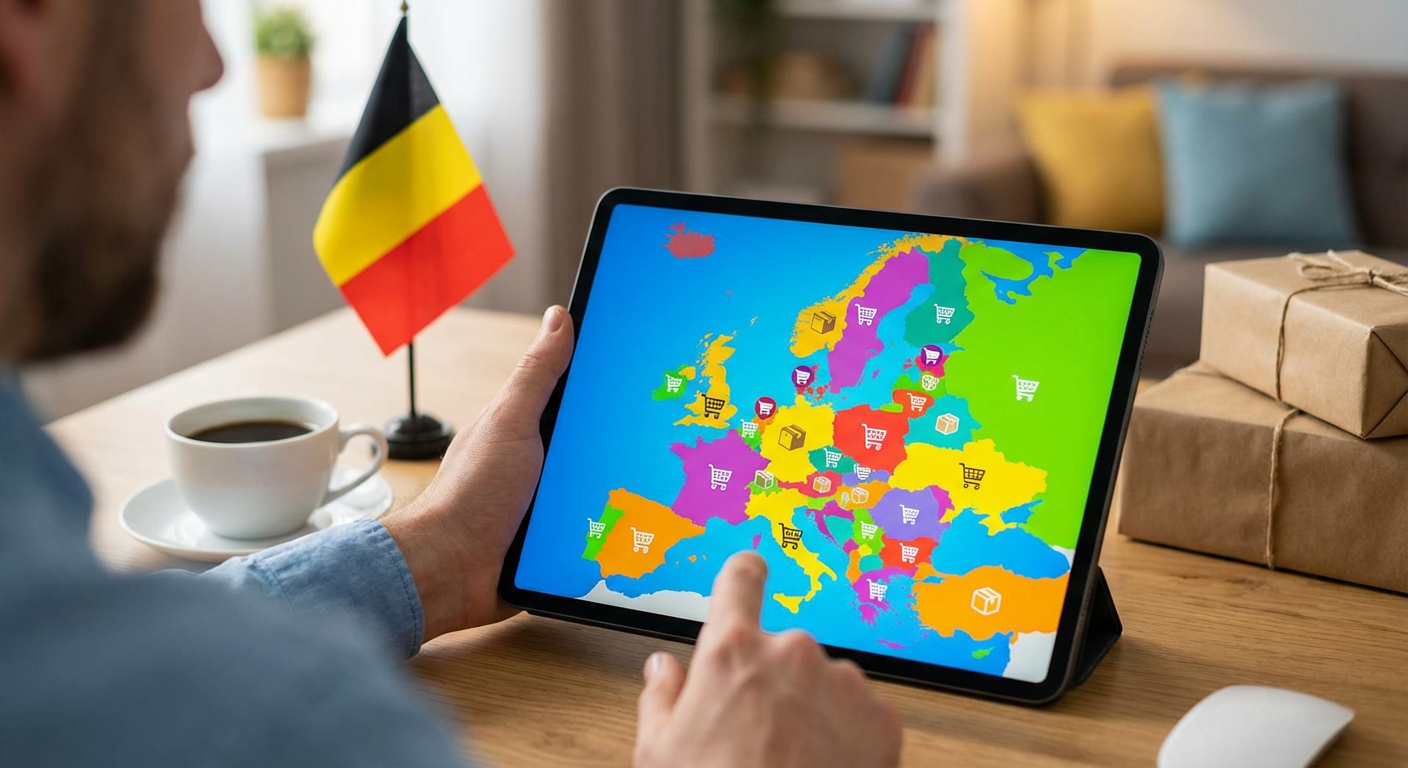
Closer to home: the Rhine, Europe's most important commercial river. In 2018 and again in 2022, water levels dropped so far that shipping partly came to a standstill. Transport on the Rhine fell by 27 per cent in the third quarter of 2018, according to McKinsey. Chemicals, raw materials, semi-finished goods — everything that has to travel along that river to factories in the Ruhr region and beyond, stalled. Germany — Europe's largest economy and the engine behind a considerable share of the continent's electronics production — saw its chemical and pharmaceutical output fall by 10 per cent in three months. Anyone who wants to understand what a Belgian seller sees when looking at the European e-commerce map has to factor in that vulnerability.
And then there are the floods themselves. In 2024, the National Bank of Belgium published an analysis of the economic impact of the July floods on Belgian businesses — based on detailed VAT data and business-to-business transactions. The finding: directly affected companies saw a 15 per cent drop in turnover in the first quarter after the flood. And it did not stay local. Companies that depended on suppliers in flooded areas — without getting wet themselves — suffered a persistent turnover loss of 0.3 per cent for every percentage point of exposure. That sounds small. It was not. There were eleven thousand businesses that bought from directly affected companies.
Where I'm going with this: when extreme weather disrupts production, paralyses logistics and sends demand soaring — because thousands of households have to replace things at the same time — a perfect storm arises in the electronics market. New products become more expensive or unavailable. Delivery times grow longer. And the consumer who is hit hardest pays the highest price.
Unless there is an alternative.
Research that already existed — and a gap that still remains
This is where it gets frustrating. Or instructive. That depends on your expectations.
Between 2007 and 2012, the European Commission funded a large-scale research project: MICRODIS — in full, Integrated Health, Social and Economic Impact of Extreme Events. The consortium, led by the Centre for Research on the Epidemiology of Disasters at UCLouvain in Brussels — the same institute that manages the international disaster database EM-DAT — brought together researchers from more than ten countries. The brief was ambitious and precise: to map the economic, social and health impact of natural disasters. Not just the major infrastructural damage — bridges, roads, railway lines — but precisely the impact at the level of households and communities.
The project was funded under the Sixth Framework Programme for Research — FP6, for anyone who can keep track of European acronyms — and produced dozens of scientific publications. A detailed article on the EEFIT mission to L'Aquila, Italy, appeared in the Bulletin of Earthquake Engineering. Italy's Istituto Superiore di Sanità integrated MICRODIS data into its national health surveillance programme. Heidelberg University organised an international symposium. UN-SPIDER, the UN knowledge portal for disaster risk reduction, included research reports on the health effects of floods in Germany and other European countries.
That research was good. That research was needed. But what it did not contain — and what is still nowhere to be found today — is how the e-commerce sector responds when those extreme events occur. No model for online buying behaviour after a disaster. No dataset on the shift from physical to digital purchasing channels in affected regions. No analysis of the role that platforms such as Bol.com or Amazon play in household recovery. And not a single reference to the circular economy as a resilience mechanism.
Honestly, I don't know whether that is a reproach. Researchers cannot study everything. But it is remarkable that fifteen years after that European-funded research, and five years after the costliest flood disaster in Belgian history, no one has made the connection between disaster recovery and e-commerce. Even though that connection is visible every day — in every order that comes in from an affected region.
The circular loop that is already running
I have something to confess. I am writing this article for a company that sells refurbished electronics. You know that — you are reading this on secondbay.be. I owe you that transparency, because what follows is not an objective analysis. It is an analysis from a position. And that position is: we are right in the middle of the system I am talking about.
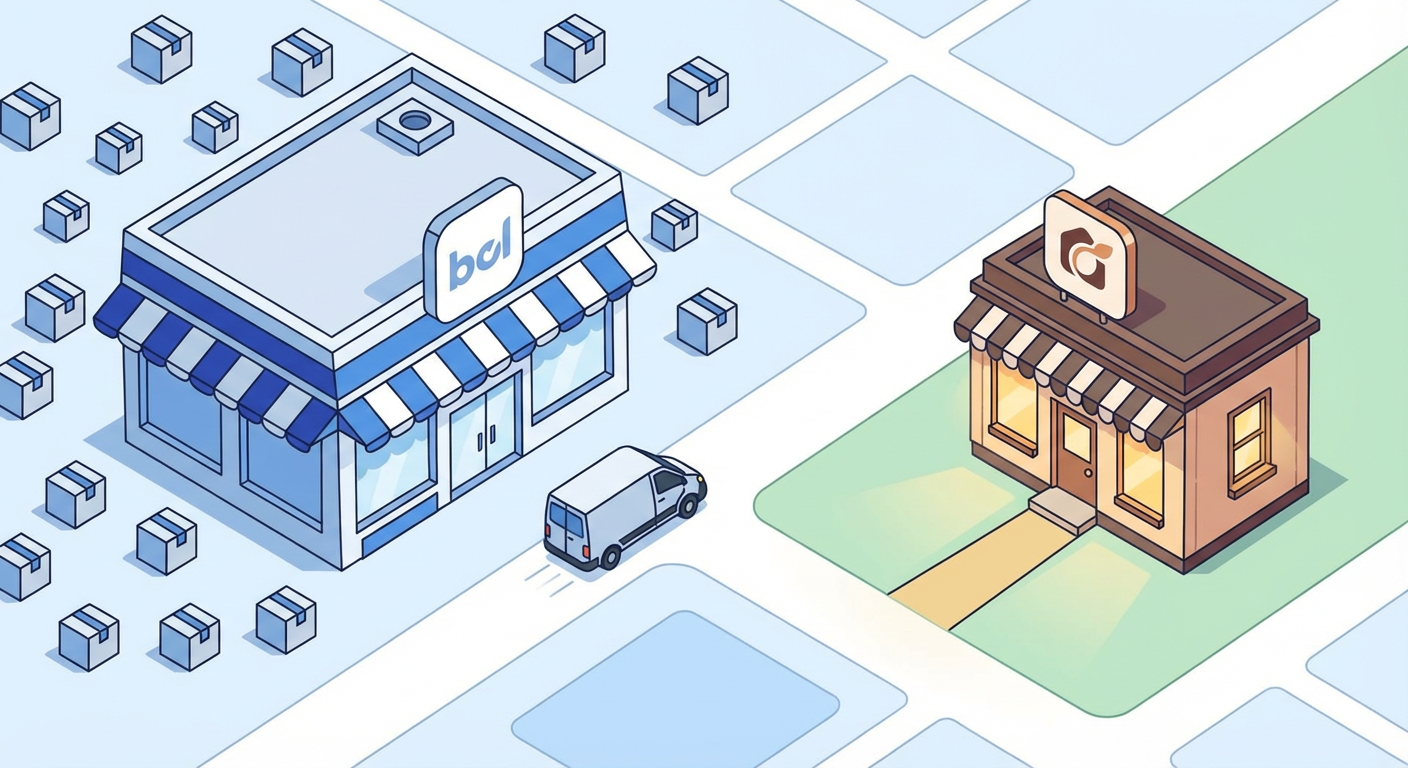
Secondbay sells via Bol.com. That means: a customer orders, we deliver, and if the product does not please them — or if the customer changes their mind, or if the colour turns out to be wrong, or for whatever reason — then it comes back as a return. That is the e-commerce ecosystem: a constant stream of products going back and forth. Bol.com alone had net consumer sales of 5.9 billion euros in 2024, spread across 14 million active customers and more than 45,000 selling partners. Every one of those partners processes returns. Every day.
What we do with those returns is exactly where the circular economy becomes concrete. Not as a policy ambition in an EU document, but as a process on a Tuesday morning. A tablet comes back. The return label is stuck crookedly on the box, the tape has been pulled off in a hurry, and when you open the lid it smells of cardboard and the faint plastic scent of new packaging material. The device itself is intact. We check it — screen, battery, ports, software. You hold it in your hand, turn it over, feel with your thumb for scratches on the back. Nothing. It works. It goes back on sale, with an honest description of its condition and the price that goes with it.
That is not a grand story. It is the logistics of every day. But it scáles. And it scales precisely at the moments when it matters.
The European market for refurbished electronics is growing by around 10 to 13 per cent a year, depending on whose estimates you read — Market Research Future cites 13.2 per cent, Coherent Market Insights puts it at 10.2. In 2025 the global market is estimated at 141 billion dollars. Europe accounts for 30 per cent of it. Platforms such as Refurbed — the Vienna-based company that crossed the threshold of 3 billion euros in cumulative trade value in early 2026, with more than 10 million products sold — show that it is no longer a niche. Back Market, Swappie, the certified-refurbished programmes of Apple and Samsung: the market is professionalising.
And the logic is compelling. A refurbished laptop costs 30 to 50 per cent less than a new one. Using a phone for one more year reduces lifecycle CO2 emissions by a third, because 95 per cent of the environmental impact lies in manufacturing — not in use. The EU is pushing with the Right to Repair and the Ecodesign Regulation. The WEEE Directive is being revised. The direction is unmistakable.
But still. That is the macro. The micro is a family in Pepinster that needs a laptop.
The bill that no one sends
Let me attempt a rough calculation. I should say straight away that the exact figures do not exist — and that that is precisely the problem.
In the ten worst-hit Walloon municipalities — category 1 in the Walloon government's classification, including Pepinster, Verviers and Chaudfontaine — the damage was catastrophic. Houses under water, ground floors destroyed. If you estimate conservatively — 25,000 households with substantial electronics damage, and an average replacement value of 2,000 euros — you arrive at 50 million euros of lost household electronics. In Belgium alone. In July 2021 alone.
And 2,000 euros is modest. A laptop: 700 euros. A smartphone: 400. A television: 500. A router, a tablet, some peripherals. You are well above that.
If those families buy new — and most do, because they do not know any better — they pay the full price at the worst possible moment. The roof needs repairing too. The floor. The boiler. Every euro counts three times over. In that context, the difference between a new laptop at 899 euros and a refurbished model at 449 euros is not trivial. That 450 euros is the difference between a child doing homework on their own screen next week, or waiting three months.
And that is whére the circular economy and e-commerce meet — not in a policy note, but in an order button. Someone in an affected region opens Bol.com. Searches for "tablet." Sorts by price. Sees a refurbished option that is 40 per cent cheaper, with a warranty, with the same delivery, via the same platform. That transaction — that one small, everyday transaction — is the circular economy in action. No theory. No policy. Practice.
The pieces that never end up on the same table
We have the research. Europe invested hundreds of millions in projects like MICRODIS to understand the impact of extreme events on households and communities. That data exists. The publications sit in academic journals, in UN portals, on university websites.
We have the market figures. The refurbished sector is growing at a double-digit rate. The EU is pushing with regulation. The circular economy is gaining ground — not as an abstract ideal, but as a business model that pays off. The platforms are there. The logistics are there. The consumer is there.
We have the disaster figures. The European Environment Agency reported €790 billion in damage from weather-related extremes in Europe between 1980 and 2023. In 2023 alone: more than €45 billion, 81 per cent of it from floods, according to the Copernicus climate report. Over the past 30 years, floods have affected 5.5 million EU citizens and caused more than €170 billion in damage, according to the European Parliament. In 2022, Europe produced more than 13 million tonnes of electronic waste — 32 kilos per European per year if you count every category.
What we don't have: a connection. No policy that, after a flood, activates a fund for affordable — refurbished if need be — replacement of household electronics. No insurance model that offers the option of replacing with refurbished at a lower premium. No disaster recovery plan that names digital rebuilding as a priority, alongside bridges and water mains. No research programme that explicitly studies e-commerce as a recovery channel.
Not to make a point, but those pieces are all there. They have simply never been put on the same table.
What remains
The European framework programme that funded MICRODIS was called the Sixth Framework Programme for Research and Technological Development. It ran from 2002 to 2006. We are now on Horizon Europe, the ninth, with a budget of €95 billion.
The 2021 floods in Wallonia cost €2.8 billion. Those of 2024 in Central Europe affected two million people. The European Environment Agency's forecasts are unambiguous: it is not going to get any less.
Bol.com delivers tomorrow. Across Belgium, across the Netherlands, to every postcode a parcel courier can reach. Fourteen million customers, 45,000 sales partners, a logistics network that runs on promises of speed and availability. That network was not designed for disasters. But it is there when the disasters come.
Somewhere in the Vesdre valley — I have no data for this, only a hunch and a handful of postcodes in our system — someone ordered a refurbished tablet in the weeks after July 2021. Not because that person was thinking about the circular economy. Not because of EU climate policy. Not because a researcher at UCLouvain had calculated that extreme events cause economic damage at household level.
But because it was €349 instead of €599.
And because the children had homework to do.
Bronnen
- Assuralia. "De verzekeringssector in cijfers: trends en overstromingen juli '21" (2021) press.assuralia.be
- Nationale Bank van België. "The Macroeconomic Effects of the 2021 Floods in Belgium" — Working Paper No. 466 (2024) nbb.be
- European Environment Agency. "Economic losses and fatalities from weather- and climate-related extremes" (2025) eea.europa.eu
- FourKites. "Flooding in Belgium, Germany and Netherlands Impacts Global Supply Chains" (2021) fourkites.com
- FutuRaM / UNITAR / WEEE Forum. "2050 Critical Raw Materials Outlook for Waste Electrical and Electronic Equipment" (2025) futuram.eu
- Eurostat. "Over 32 kg/person of new electrical & electronic gear" (2025) ec.europa.eu
- Europees Parlement / Raad van de EU. "Richtlijn (EU) 2024/1799" — Right to Repair" (2024) eur-lex.europa.eu