
One autumn evening (I no longer remember exactly when, but it was raining, that much I remember) I sat at my laptop staring at a product page on Bol.com. It was one of our own listings. A returned Bose speaker, in fine condition, tested, cleaned, with an honest description and three photos.
The description was good. Technically correct, every spec right. But it was also exactly the same format as the thousands of other listings on the platform. The same bullet points. The same structure. The same limits. I couldn't explain that this speaker had once been sent back because the customer found it "too loud", which is really a compliment for a Bose. I couldn't say that we had tested it at six different volume levels. I couldn't show who was behind that listing.
That evening I started thinking about a webshop of our own. Not as a replacement for the marketplaces (that would be commercial suicide) but as something alongside them. A place where the story did fit.
The number nobody talks about: 47,000
At the end of 2024, Bol.com had 47,000 sales partners. That is fewer than you might think, and fewer than there used to be. At the peak, in mid-2023, there were almost 52,000. Since then the number has been falling. Ecommerce News Nederland reported this in February 2025, based on figures published by Bol's parent company Ahold Delhaize.
At the same time, Bol's own revenue grew faster than that of its partners. In 2024 net revenue rose by 8.7% to 3.1 billion euros, while the partners' share of total sales volume fell from around two thirds to barely half. Bol now earns more from its own sales than from all its partners put together.
I'm not writing this to run Bol down. Bol is a very good platform; we still sell through it every day. But those figures tell a story every marketplace seller should know: you are building on someone else's land. And someone else's land can shift.
The springboard
eBay once called itself a "Sprungbrett für Gründer", a springboard for entrepreneurs. Germany's Händlerbund, the trade association for online retail, picked that up. The trade publication etailment covered it in its daily briefing on the European e-commerce sector. And the British company Expandly wrote an article headlined "It Could Be You — eBay Millionaires", about how the platform had launched entrepreneurs to million-euro turnovers.
I recognise that picture. Partly.
The marketplaces really were our springboard. Without eBay and Bol.com we could never have started: we have told that story at length. No start-up capital needed for a webshop, no investment in a payment system, no marketing budget to reach the first customer. You put a product online, and the customer is already there. Millions of customers, ready to buy.
But a springboard is not a foundation. A springboard is something you jump off. And the moment we realised that (not as a eureka moment but as a slowly growing unease) was the moment Secondbay began to exist as a brand in its own right.
What you learn as one of the 47,000
There are things you only learn by selling on a marketplace for years. Things that are in no e-commerce handbook, but that every seller recognises.
You learn that the commission is more than a percentage. On Bol.com you pay, depending on the category, between 5 and 17% per sale, plus a fixed amount per item. On eBay it's similar. That sounds simple until you start doing the maths. Commission plus shipping costs plus VAT plus the cost of a return you don't pass on, and then you look at what is left of that 67-euro speaker and think: I could just as well have bought a sandwich with that.
I'm exaggerating. A little.
You learn that you have no control over your own visibility. The platform decides who appears at the top. The buy box on Bol.com goes to whoever has the best combination of price, delivery time and sales performance, and if a bigger seller decides to offer the same product for two euros less, you drop out of sight. Just like that.
You learn that your customer relationship isn't really a customer relationship. The customer buys from Bol.com. Not from you. If that customer needs a speaker again in two months, they go to Bol.com, not to you. You are a supplier, not a brand.
And you learn (for us this was the decisive lesson) that there are things you cannot tell on a marketplace. Why a returned product is sometimes better than a new one. What your testing process looks like. Why that little scratch on the back doesn't matter. The story behind the product doesn't fit into a two-hundred-word Bol.com listing.
Why not just leave?
That's the question you would expect in this kind of article. The "and then we decided to go our own way" moment. The farewell to the platforms, the leap to independence.
That is not our story. And I think for most sellers it isn't the right story.
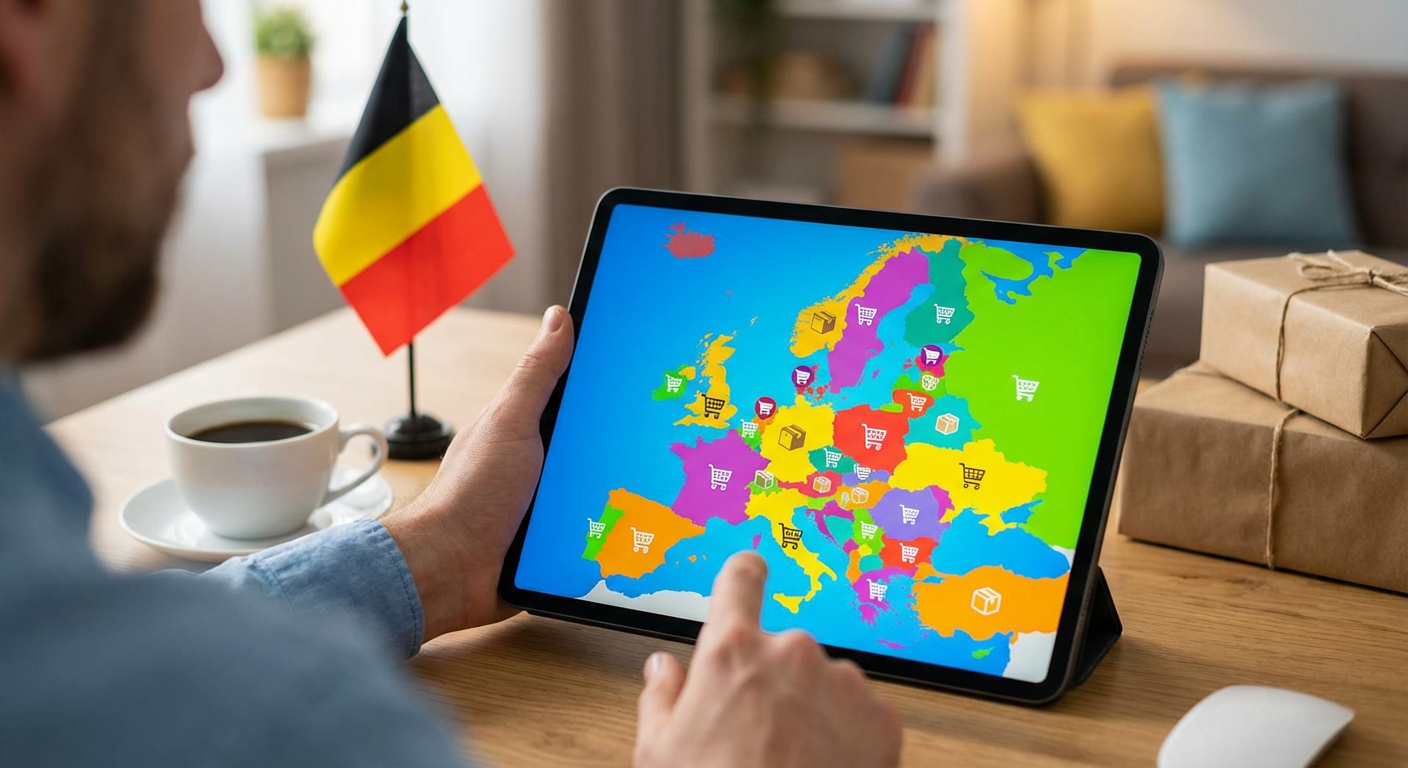
The figures are relentless. In Germany, the second-largest e-commerce market in Europe after the United Kingdom, all of the growth in online sales in 2024 came from marketplaces. According to an analysis by Marketplace Universe based on the HDE Online Monitor 2025, webshops without a marketplace connection saw their revenue fall by 5.4% on average, while marketplaces grew by 8.8%. Amazon alone has a 63% share of the German online market.
Leaving the marketplaces is not an option for most sellers. It is commercial suicide.
But staying completely dependent is a different kind of risk. Bol lost 5,000 partners in two years. Not because they all stopped: some grew, some merged, some did indeed stop. But the trend is clear: the platform is becoming more selective, its own sales are becoming more prominent, and the margin for partners is getting thinner.
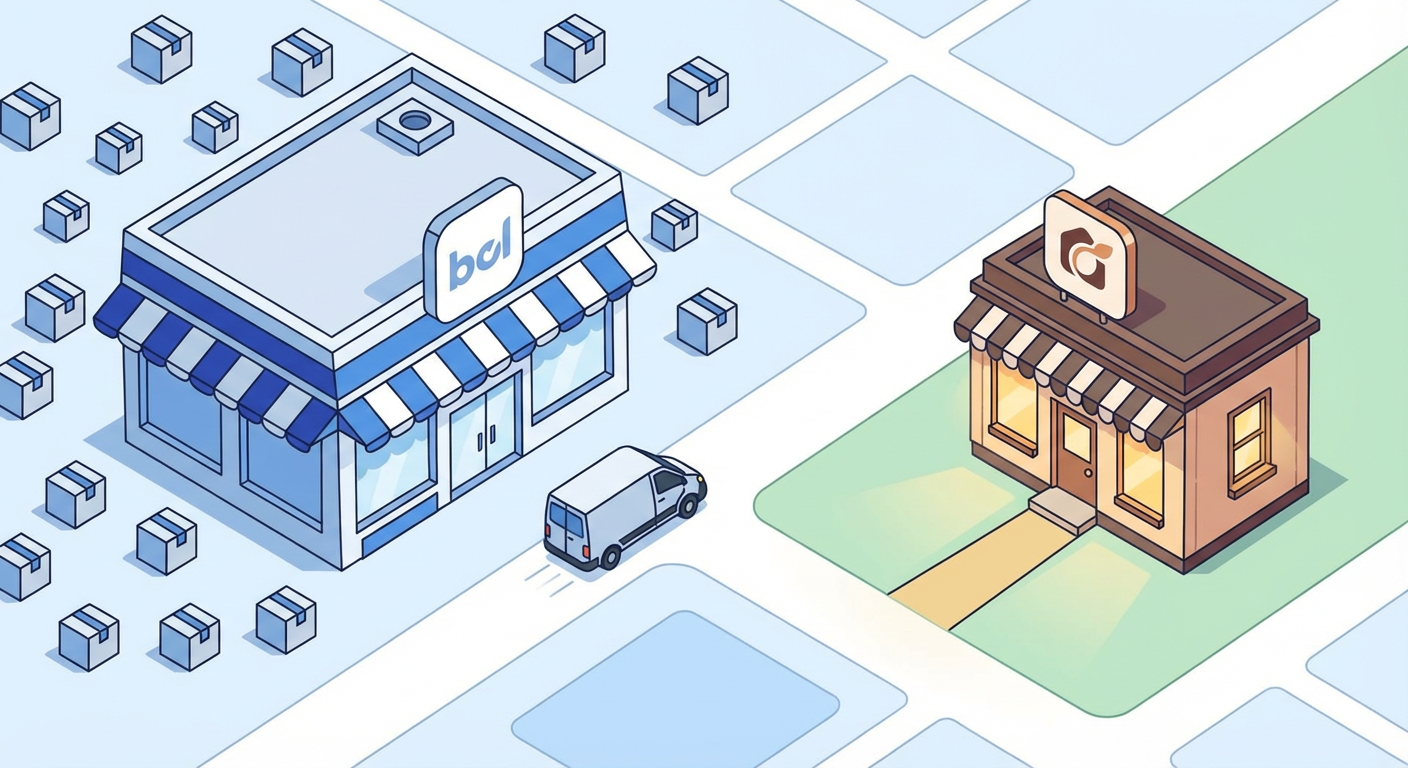
Our solution was not to choose. Not marketplace or webshop. But marketplace and webshop. The marketplaces for volume, visibility and the flow of customers. Our own webshop for the story, the margin and the relationship with the customer.
What a webshop of your own can do
On secondbay.be we can do things that fit on no platform.
We can explain exactly what a return deal is. Not in a bullet point but in a paragraph. We can show how our testing process works. We can list a product as B-grade with a photo of that one particular scratch and an explanation of why it doesn't matter, or why it does.
We can set a price without an algorithm deciding that we are too expensive compared with a competitor who offers the same product, but without testing it.
We can recognise a customer who comes back. Not through a tracking system but because we still know their previous order. And we can send them an email when something comes in that we think they might find interesting.
And we can write. This article, for example. About who we are, how we work and why we do what we do. Or a piece about the 14.4 million tonnes of electronics that Europe puts on the market every year, and where they end up when nobody wants them any more. That doesn't fit on a Bol.com product page. Here it does.
The downside, to be fair
A webshop of your own sounds like freedom. And it is, partly. But it is also work you don't have on a marketplace.
On Bol.com and eBay the customer comes to you. On your own webshop you have to bring the customer to you. That is a fundamental difference. It means thinking about findability, about content, about why someone should trust you rather than the platform they already know.
It means investing in something that gives no immediate return. A blog nobody reads in the first months. An about page you rewrite three times. A shipping page you have to set up yourself instead of leaving the logistics to the platform.
And it means accepting that your webshop (certainly at the start) does a fraction of the volume of your marketplace sales. Our Bol.com sales still far exceed our webshop sales. That is nothing to be ashamed of. It is reality. The Belgian market is small but loyal, and for now that is enough for us.
But every sale through our own webshop is a sale with a better margin, a direct customer relationship, and a story we can tell ourselves. And that number is growing. Slowly, but it is growing.
What I would say to a seller who is thinking about it
Not: "do it now." But: "start thinking about it."
The marketplaces are not your enemy. They are your springboard; that word is exactly right. But a springboard is by definition temporary. At some point you either stand still or you jump.
Start small. A simple webshop with your ten best-selling products. No large range, no complex logistics. Just a place with your name on it where you can tell the story that doesn't fit on the platform.
Don't count on volume in the first year. Count on learning. Learning how customers find you. Learning what they want to know that a marketplace listing doesn't tell them. Learning what it feels like to have a customer who buys from you, not from the platform.
And keep selling on the marketplaces. The two don't exclude each other. We still sell through Bol.com and eBay every day. And we're not going to stop. But we sleep a little easier at night knowing that if Bol decides tomorrow to change our category, raise our commission or review our buy box position, we have an address of our own to send customers to.
That address of our own is not a luxury. It is insurance.
That Bose speaker from the rainy evening
It has been sold. Through the webshop, not through Bol.com. The buyer was someone from Bruges looking for a present for his wife. He had read the product page, the whole product page, with the story about the "too loud" return and the six volume levels. He sent a short email: "That bit about the six volume levels, is it true?"
It's true, I wrote back. We test every product.
He ordered. The speaker went to Bruges with bpost. His wife found it (so we hear) too loud indeed.
But she kept it.
Bronnen
- Ecommerce News Nederland. "Bol verdient meer dan al zijn partners" (2025) ecommercenews.nl
- Bol. "com Partnerplatform. "Commissietarieven" (2025) partnerplatform.bol.com
- HDE / Handelsverband Deutschland. "HDE Online-Monitor 2025" (2025) — betaalde publicatie; samenvatting via Ecommerce News Europe: ecommercenews.eu
- Marketplace Universe. "The German Online Market 2025" (2025) marketplace-universe.com
- Onlinehändler-news. "de. "Ebay sieht sich als Sprungbrett für Gründer" (2017) onlinehaendler-news.de
- Expandly/Amivo. "It Could Be You – eBay Millionaires" (2017) expandly.com
- Reuters via Yahoo Finance. "eBay millionaire sellers in Germany and UK grow 50 percent in four years" (2017) finance.yahoo.com
- Euromonitor. "Beyond E-Commerce: The Marketplace Wave Reshaping Western Europe's Retail Landscape" (2025) euromonitor.com