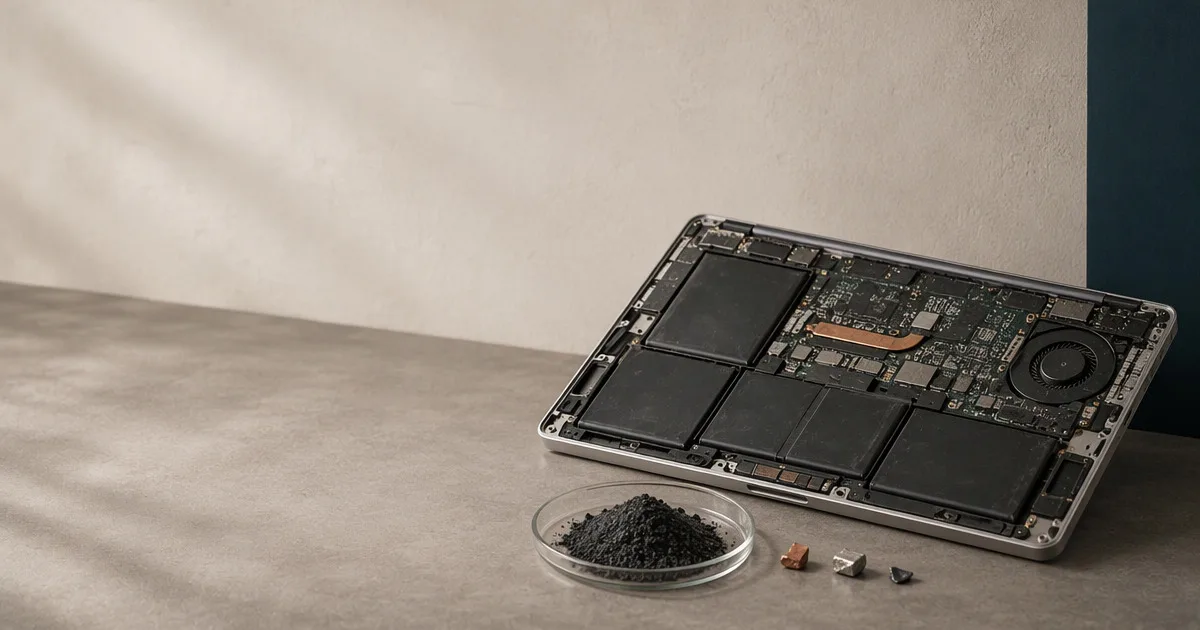

The powder is dark grey, almost black. In the battery industry they call it 'black mass' — the finely ground remains of lithium batteries once the casing, electronics and plastics have been removed. This powder contains the metals that matter: cobalt, nickel, manganese, lithium.
It is placed in a bath of sulphuric acid. Slowly the metals dissolve, each with its own reaction time and its own concentration. After hours of dissolving, filtering, precipitating and purifying again, you have — if all goes well — metal salts pure enough to be processed into a battery once more.
That process is called leaching. It is the core of a technology in which Europe will invest billions over the coming years: hydrometallurgy. Wet separation of metals from waste. It is related to the technique that the Horizon 2020 project CHROMIC investigated to recover chromium, vanadium, molybdenum and niobium from steel slag — the process we described earlier.
But the same chemistry plays a key role in something that affects us directly as an electronics seller: the recycling of the lithium batteries in the laptops, smartphones and headphones that pass through our hands every day.
Two processes, one challenge
Look. Broadly speaking, there are two ways to recover metals from electronic waste. The first is pyrometallurgy — smelting at extreme temperatures, the process Umicore uses in Hoboken for circuit boards and processors. Effective for gold, silver, platinum and copper.
But during smelting, lithium is lost in the slag. Lithium oxide is thermodynamically too stable to be reduced at smelting temperatures — it remains as an oxide in the slag while cobalt, nickel and copper sink to the bottom as metal.
The second way is hydrometallurgy: dissolving instead of smelting. You place the material in an acid bath — sulphuric acid, hydrochloric acid, nitric acid, or organic variants such as citric acid — and the metals go into solution. Then you separate them step by step by changing the conditions: temperature, acidity, the addition of a precipitating agent. Each metal reacts slightly differently, and you build the whole process on those differences.
Honestly, that sounds more elegant than it is. In practice you are dealing with dozens of elements dissolving at the same time, with unwanted side reactions, with toxic by-products, and with wastewater that itself has to be treated. Every type of waste requires a different recipe.
From steel slag to lithium battery — the same chemistry, a different recipe
CHROMIC, the European research project coordinated by VITO in Mol, focused on a combined approach for steel slag: alkaline roasting at high temperature, followed by water leaching to dissolve the chromium out of the roasted material. Concretely: ferrochrome slags were mixed with sodium hydroxide and heated. The result was impressive: more than 95% of the chromium was recovered. But the process required conversion to the toxic hexavalent chromium, a problem that had still not been solved by the end of the project.
With lithium batteries the recipe is different but the logic is identical. The cathode materials — the 'black powder' already mentioned above — are dissolved in an acid bath. Cobalt, nickel, manganese and lithium each go into solution at their own moment. Through selective precipitation you separate them: you add substances that cause one metal to precipitate while the rest stays in solution.
Not to put too fine a point on it, but the recovery rates in the lab are high: 98% for cobalt, 99% for lithium under certain process conditions. The step to the factory is where it gets difficult.
What goes wrong between lab and factory
In a laboratory you work with pure cathode material that you have prepared yourself. In practice, mixed battery streams come in — different chemistries, different ages, different contaminants. One lithium battery contains cobalt, another does not. One has an aluminium casing, another steel. Every variable changes the leaching recipe.
And then there is the wastewater. Hydrometallurgy consumes large quantities of acid and alkali. The sulphate waste that remains must be treated or landfilled. Energy consumption is lower than with smelting, but the chemical complexity is higher. One wrong pH value and you lose selectivity — the metals you want to separate precipitate together instead of apart.
Still, the pressure to make it work is enormous. The EU Battery Regulation of 2023 requires that by the end of 2027 at least 90% of the cobalt, copper and nickel from waste batteries must be recovered, and 50% of the lithium. By 2031 that rises to 95% for cobalt and nickel, and 80% for lithium. These are not optional ambitions — they are legal obligations.
In Belgium, Umicore combines both techniques for battery recycling — with a capacity of 7,000 tonnes per year, one of the largest in Europe. First smelting to concentrate the most valuable metals, then wet separation to purify them. A hybrid approach, born from the same reality that CHROMIC encountered with steel slag: no single process does everything well.
What CHROMIC teaches us about the limits of recovery
That aside: the CHROMIC research and the twelve related Horizon 2020 projects — from NEMO and CROCODILE to TARANTULA and SOCRATES — have made one thing clear. The technology to recover critical raw materials from secondary sources exists. Roasting followed by leaching works for chromium from slag. Acid leaching works for cobalt from batteries.
But every process has an Achilles heel: toxic intermediates, impurities that disrupt selectivity, economic unviability when raw material prices are low, or simply the variability of the waste stream. The academic publications of the CHROMIC consortium in journals such as Springer document those process conditions down to the detail. Europe is building a scientific foundation under the circular economy. But the distance from laboratory to factory is longer than a paper.
The calculation that comes before the chemistry
As a seller of refurbished electronics, we stand on the other side of that chain. Not at the acid baths and the smelter, but at the moment when a product can still get a second life — before the whole recycling chemistry is set in motion.
Every Belgian household owns an average of 106 electronic devices. A smartphone battery contains five to ten grams of cobalt. A laptop slightly more. That sounds like little — but these are metals that even with the best available technology we recover at 90% to 95%, after an energy- and chemical-intensive process whose scaling up is still very much in development.
And that is the best-case scenario — the Battery Regulation accepts that until 2031 half of the lithium is lost.
That makes every working device you keep out of the recycling stream valuable. Not in the abstract, but in concrete chemistry: the cobalt that stays in that laptop's battery does not have to go through a separation process. The lithium that disappears as an oxide in the slag during pyrometallurgy does not disappear if the laptop simply gets a new owner.
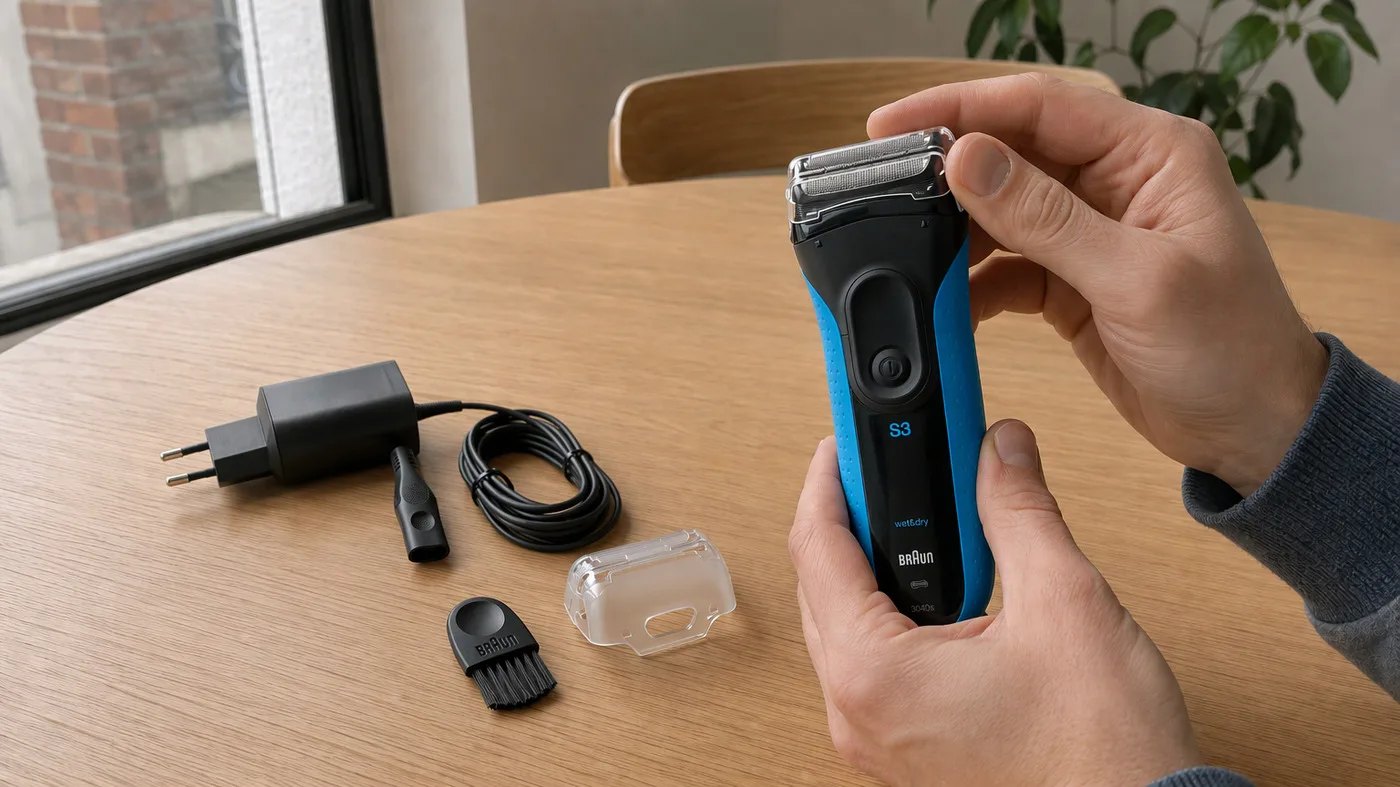
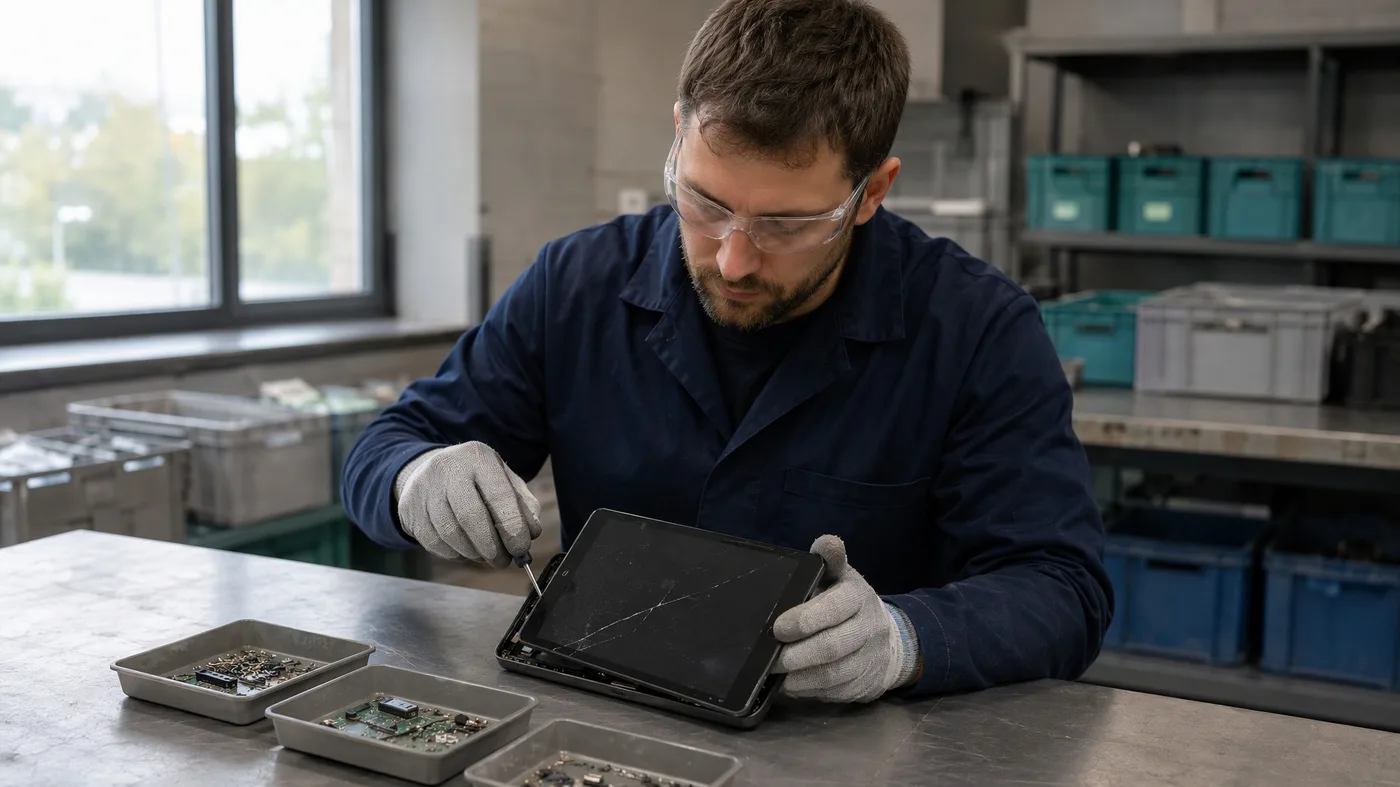
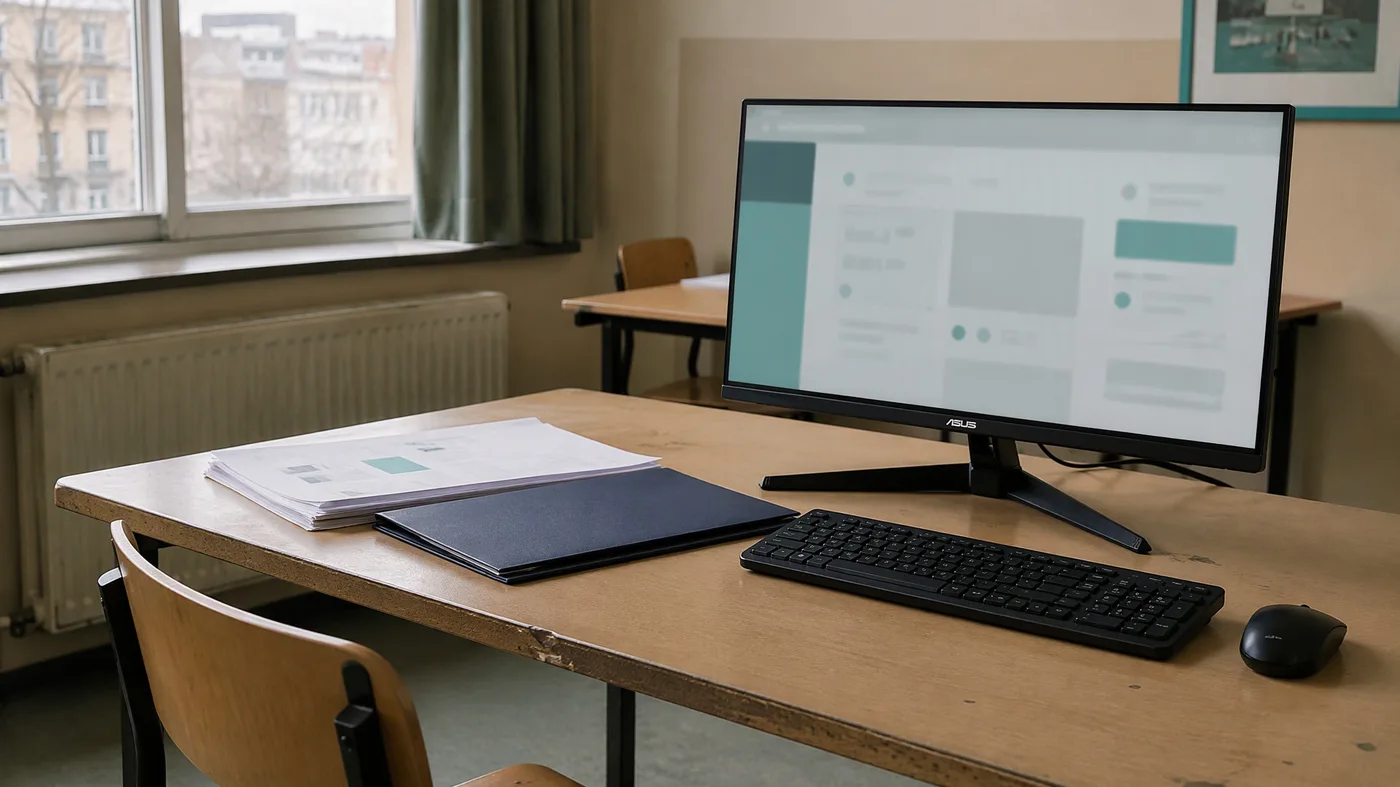
We see that every day at SecondBay. The returns that reach us from Bol.com — monitors, tablets, headphones — are devices that can last for years. We check them, inspect them and offer them again. With a warranty.
It is a step that comes before the leaching, before the smelter, before the chemical separation. Not as a replacement for Recupel or Umicore — that chain exists and it is needed. But as a first step towards sustainability, before all that chemistry is needed.
The EU Battery Regulation pushes the industry towards ever higher recovery percentages. The Right to Repair Directive makes reuse and repair more accessible. The European refurbished market, which grows by more than 13% a year, pushes from the other side: a longer life before the recycling process begins. The European policy framework is converging on the same point.
Chromium from a slag, cobalt from a battery
Somewhere in a laboratory in Mol there is a set of glass flasks in which VITO researchers optimised the combined roasting and leaching process for ferrochrome slags. Somewhere in Hoboken there is an industrial plant in which Umicore uses acid baths at scale to extract cobalt and nickel from lithium batteries. The scale differs. The metals differ. But the principle is related: you make the metals available, you separate them, you purify them.
The science works. Scaling up is the problem. And as long as the recycling chain still loses so much — lithium in the slag, impurities in the acid bath, energy in the process — every device that lasts longer is a device that bridges that gap.
In our warehouse in Ghent there are devices that make that difference. Not by extracting chromium from slags or precipitating cobalt from acid baths. But by giving a working laptop, a working tablet, a working pair of headphones a second owner. That is the simplest step in the circular economy. And it is the step that requires the least chemistry.