Sixty-two out of a hundred and fourteen. That is the number that stayed with me when I read the study. Sixty-two respondents in the Vesdre valley who — two to three years after the floods of July 2021 — said their psychosocial wellbeing was still worse than before. Nele De Maeyer and her team at Ghent University published the results in early 2025 in the journal Climate. It is one of the few studies that does not look at the immediate aftermath, but at what remains once the cameras have gone and the emergency aid has dried up.
Twenty-nine of those sixty-two described their situation as "considerably worse." Not a little. Considerably.
Anxiety when it rains. Loss of attachment to one's own home. Financial, physical and mental damage that run into one another — because that is what they do, in real life, to people who have watched their house fill with water.
This article is not about psychology. At least, not only. It is about a question nobody asks: what happens to your healthcare when the water takes not only your home but also your digital access?
What floods do to health — the research
The health effects of floods are better documented than you might think. And worse than you might hope.
Between 2007 and 2012, the European Commission funded the research project MICRODIS — Integrated Health, Social and Economic Impact of Extreme Events — led by the Centre for Research on the Epidemiology of Disasters at UCLouvain in Brussels. The project, funded under the Sixth Framework Programme for Research (FP6), brought researchers together to map the impact of natural disasters on households and communities. One of the research reports, included in the UN-SPIDER knowledge portal, analysed specifically the health effects of natural disasters in Germany and other selected European countries. Another report, cited by Evidence Aid, offered a systematic overview of the health and healthcare system impact of earthquakes, storms and floods.
The findings were not surprising to anyone who stops to think about them, but confronting when you line them up. Floods cause more than water damage. They cause infectious diseases through contaminated water and overflowing sewers. Skin conditions. Respiratory problems from mould in damp homes — months, sometimes years after the flood. Injuries during evacuation and clean-up. And then the mental side: post-traumatic stress disorder, depression, anxiety disorders, sleep problems.
A systematic review and meta-analysis in Frontiers in Psychiatry from 2022, which summarised 23 studies, confirmed what disaster researchers had long known: PTSD prevalence among flood victims is structurally high, and the figures vary widely depending on the severity of exposure, the socioeconomic position of the affected population, and the availability of professional help. Precisely those factors that in Wallonia — where the ten hardest-hit municipalities housed predominantly lower-income groups — pointed in an unfavourable direction.
Look. Belgium scores poorly on psychotrauma care. That is not my opinion — it is stated in a report by the Belgian federal government itself. There is no certified and publicly accessible network of psychotrauma therapists, there is little public awareness of PTSD as a concept, and the initiatives around trauma care are — compared with countries such as the United States — relatively new. A research team from VUB wrote this back in 2021, in the journal Frontiers in Psychiatry, in the wake of the terrorist attacks in Brussels. That same structural shortfall hit the flood victims of the Vesdre valley a few months later.
The digital promise
And then came the twist that nobody had planned.
The COVID-19 pandemic — which began a year and a half before the floods — had caused an unprecedented acceleration in digital healthcare across Europe. Video consultations with the GP. Telepsychiatry. Digital prescriptions. Online appointments. Apps for psychological support. Belgium developed eHealth action plans, launched the national eHealth platform, and in the EU indicators survey of 2024 scored the maximum: 100 per cent maturity on digital health services — the highest score in the EU, above Denmark and Estonia, which stalled at 98 per cent.
In September 2024, the Belgian parliament adopted a resolution to make digital health applications more accessible and affordable. The federal government is working on the Belgian Integrated Health Record — a centralised digital patient record intended to connect care providers, hospitals and GPs. The direction is unambiguous: healthcare is going digital. Not as an option, but as a foundation.
But then. A digital foundation requires a digital floor. And that floor consists of devices.
A tablet. A smartphone. A laptop with a working camera and a stable internet connection. Those are the minimum requirements for a video consultation with your GP, for opening your electronic patient record, for requesting a psychological referral through your health insurance fund's portal.
And they are precisely the things that are the first to go when your house is under water.
The gap nobody measures
Here two realities intersect, and the result is a blind spot in disaster policy.
On one side: a care system that is becoming ever more digital and increasingly requires patients to connect themselves — online, via a device, with an account and a password they have to remember.
On the other: a flood that renders every device in a household unusable in a single night. And not just the devices — the router, the modem, the chargers, the cables too. The entire digital infrastructure at household level.
In the Vesdre valley it took eleven months before the last communities had telecommunications again. Eleven months. In a country where your GP offers video consultations, where your health insurance fund has an app, where your psychologist has partly switched to online sessions since the pandemic. How do you ask for psychological help — help you demonstrably need, the data is there — when you have no device to reach that help with?
The National Digital Inclusion Alliance — an American institute, but their analysis is universal — published a detailed framework for digital inclusion in disaster recovery at the end of 2024. Their recommendation, freely quoted: work with technology companies, non-profit device refurbishers and government bodies to provide replacement smartphones, tablets and laptops to families whose devices were lost or damaged in the disaster. Prioritise vulnerable groups — low incomes, older people, families with school-age children.
That is America. In Belgium there is no equivalent policy. No disaster recovery programme that names "replacement of digital devices" as a priority. No collaboration with refurbishers after a flood. Physical reconstruction — bridges, roads, homes — rightly receives attention and funding. Digital reconstruction is left to the individual.
Honestly: I get it. Policymakers think in infrastructure. Cables, masts, power stations. Those were repaired — with delay, but they were repaired. What nobody thinks about is the last metre: the device on the kitchen table. That device is private property. The government does not replace it. The insurer may cover it, if the policy allows. And the family that has just had to replace its boiler and floor does not have 900 euro spare for a new laptop.
The concrete cost of a lost tablet
Let me be concrete for a moment, because otherwise this gets too abstract.
A family in Pepinster. Two parents, two children at secondary school. The water has destroyed the ground floor. The insurance covers the structural damage — partly. The car is a total loss. The boiler has to be replaced. The floor. The kitchen worktop.
The family laptop was in the living room. The children's tablets were on the coffee table. The router stood next to the television. All gone.
What that means in the weeks and months that follow:
No video consultation with the GP for the mother who has not slept for three weeks and flinches at every drop of rain — that is an economic impact that appears in no damage report. No online appointment with the physiotherapist for the father with back problems from the clean-up work. No Smartschool for the children — Belgium's most widely used digital learning platform — which means: missed lessons, missed deadlines, missed tests. No access to the OCMW website to apply for financial support. No banking app to keep track of the repair costs.
The cost of a new laptop: 899 euro. The cost of a refurbished laptop: 449 euro. The difference: 450 euro that can go towards the boiler, or the floor, or the first instalment of the psychologist the children need because they no longer dare to sleep when it rains.
And if you work that out for 25,000 households with substantial damage — the figure I estimated in an earlier article — then you are talking about millions of euros of difference between new and refurbished. Millions that stay in affected families, instead of going to factories in Shenzhen.
What we see — and what we don't claim
I have to offer the same transparency here as always: we sell refurbished electronics via Bol.com. That is our business. What follows is not a neutral analysis — it is an observation from a position.
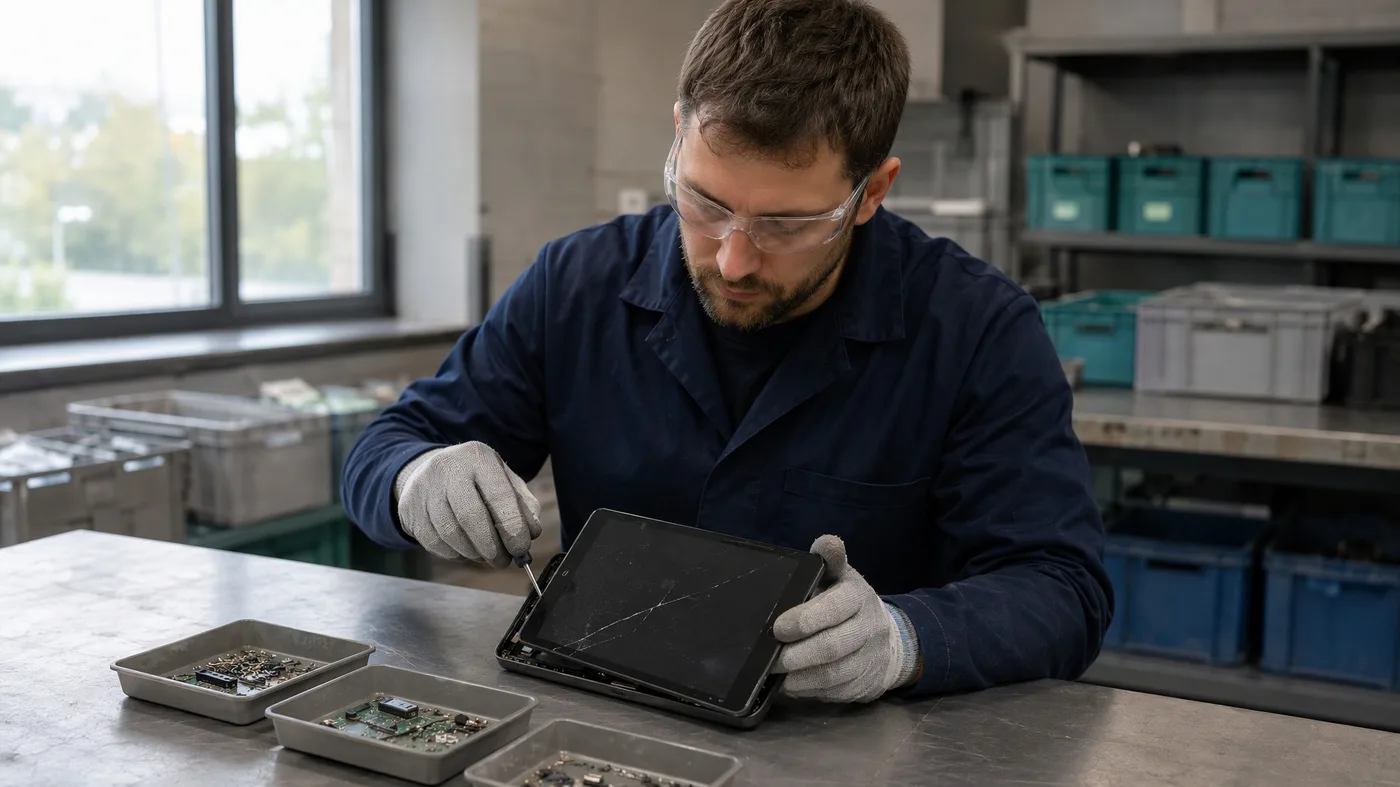
At Secondbay we process returns from our own sales. Every day. A tablet that comes back because the customer wanted a different model after all. A laptop that has been taken out of the box, switched on, and sent back — the protective film is sometimes still on it. We check those devices, describe their condition honestly, and offer them again. With a two-year warranty. That is the circular economy at its most concrete — not as theory, but as a Tuesday.
What we don't claim: that we are the solution to disaster recovery. We are not. We are a web shop. But we are a web shop that offers a refurbished tablet for 349 euro where the same tablet costs 599 new. And if a family in an affected region orders that tablet via Bol.com — delivered tomorrow, anywhere in Belgium — then that is not charity. That is a transaction. But it is a transaction that makes it possible for a child to get back onto Smartschool, for a mother to video-call her GP, for a father to submit his social services application online.
That one transaction. That is what digital inclusion means in practice.
The pieces on the table
We now know how floods affect health — the MICRODIS project and dozens of follow-up studies have established that. We know that the mental health impact is long-lasting — two to three years after the flood, in the Vesdre valley, more than half of those affected are still not doing better. We know that healthcare has gone digital — Belgium scores 100 per cent on the EU maturity index, parliament is pushing it through, the Belgian Integrated Health Record is on its way.
What we also know: Europeans consume tens of kilos of electronics per person every year, the e-waste mountain is growing, and the refurbished market offers an alternative that is both cheaper and more sustainable. That alternative exists. It is within reach. It gets delivered.
What is missing: the policy that connects these pieces. No programme that says after a flood: here are refurbished devices for affected families, so they can restore their digital access to healthcare, education and public services. No insurance option that offers refurbished at a lower excess. No disaster plan that names digital reconstruction as a health priority.
Not to make a point, but the data is there. The technology is there. The logistics are there. The only thing missing is someone who puts these pieces on the same table.
What remains
The EU research into the health impact of natural disasters — from MICRODIS to the current Horizon Europe projects — has proved one thing beyond doubt: the damage does not stop when the water recedes. That is when it begins.
The European Environment Agency reported 790 billion euro in damage from weather-related extremes between 1980 and 2023. In Wallonia alone: 2.8 billion in July 2021. Thirty-nine dead. More than 71,000 damage claims. And sixty-two of the 114 respondents in a study still functioning worse two years later than before.
Somewhere in the Vesdre valley — it could be in Pepinster, or in Verviers, or in Chaudfontaine — someone is trying to make an appointment with a psychologist. The GP recommended it. The referral is there. The number is on a note on the kitchen counter.
But it is a practice that has been working with video consultations since the pandemic. And the laptop is still lying in a container at the recycling centre.
A refurbished one costs 449 euro.
That 449 euro appears in no disaster recovery plan.